More businesses are now putting AI agents on the phone for support, sales, collections, and follow-ups. And when teams start shortlisting platforms, two names often come up together: Vapi and JAM. Both help businesses run AI voice agents, but they are built for quite different buyers.
That’s why a clear Vapi vs JAM breakdown is useful before signing up for either one. Vapi is a developer platform that lets technical teams build their own voice agents. JAM is a managed enterprise voice AI platform built around Indian languages, Indian calling rules, and high-volume business workflows.
So if you are new to this voice AI platform comparison, this guide covers what each platform does, how pricing works, where each one fits, and what Indian businesses should check before choosing.
What is Vapi AI & who is it built for
Here, what Vapi means is simple: it is a developer-focused platform for building, testing and deploying voice AI agents. Vapi works as an orchestration layer. Teams pick their own speech-to-text, language model and text-to-speech providers, connect a phone number and then build the agent through APIs, SDKs or the dashboard.
- Built for: Developers and technical teams that want full control over the voice stack.
- Model choice: Teams can connect providers like Deepgram, OpenAI, ElevenLabs or Azure, and bring their own API keys.
- Pricing style: A per-minute platform fee, with model and telephony costs on top.
- Compliance: Vapi’s trust centre lists SOC 2, HIPAA and GDPR among its standards.
Well, this flexibility is Vapi’s biggest strength. But it also means the business needs engineers to design, connect, test, and maintain the agent.
What is JAM & what does this JAM AI review cover
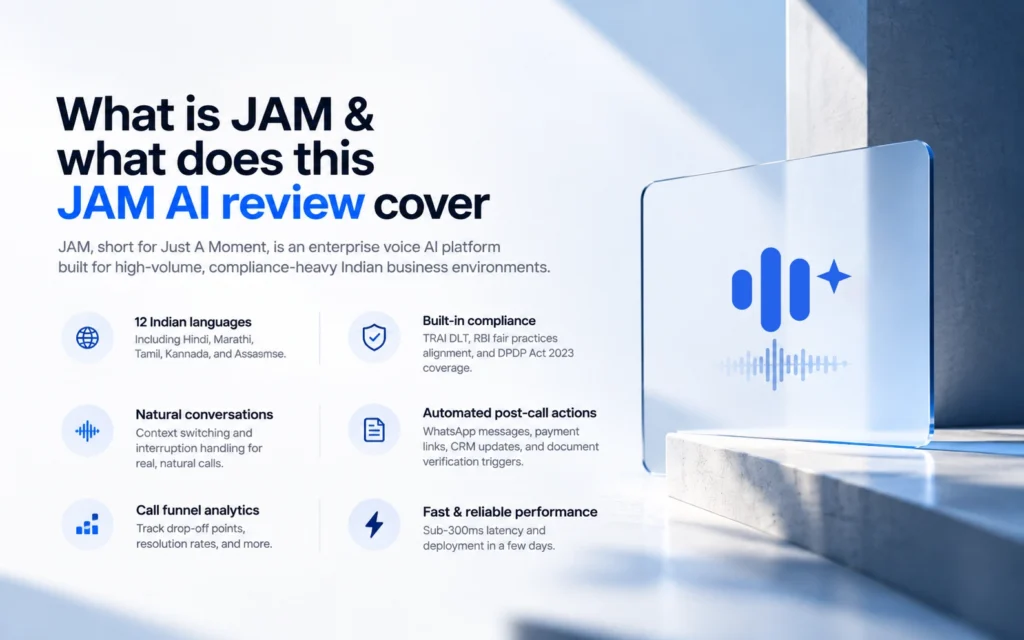
JAM, short for Just A Moment, is an enterprise voice AI platform built for high-volume, compliance-heavy Indian business environments. Instead of handing teams a set of building blocks, the JAM AI voice agent comes ready for real business calls like collections, EMI reminders, lead qualification, COD verification, and customer support.
This JAM AI review looks at what JAM offers as per its own product information:
- 12 Indian languages supported natively, including Hindi, Marathi, Tamil, Kannada, and Assamese
- Context switching and interruption handling for natural conversations
- TRAI DLT compliance, RBI fair practices alignment, and DPDP Act 2023 coverage built into the platform
- Custom post-call actions like WhatsApp messages, payment links, CRM updates, and document verification triggers
- Call funnel analytics with drop-off points and resolution rates
- Sub-300ms latency and deployment in a few days
So the JAM AI voice agent is less about building from scratch and more about getting a working, compliant workflow live quickly.
Comparison of Vapi vs JAM: Features, pricing & fit at a glance
The comparison Vapi vs JAM becomes much easier to understand in a single table.
| Factor | Vapi | JAM |
| Type of platform | Developer orchestration platform | Managed enterprise voice AI platform |
| Best suited for | Technical teams building custom agents | Indian businesses running high-volume calls |
| Setup effort | Engineering team builds and maintains the agent | Workflows set up with JAM, deploys in a few days (as stated by JAM) |
| Indian languages | Depends on the speech and voice providers chosen | 12 Indian languages supported natively |
| India-specific compliance | Business needs to plan TRAI and DPDP handling itself | TRAI DLT and DPDP Act 2023 coverage built in |
| Pricing | $0.05 per minute platform fee plus model and telephony costs | Custom, based on business requirements |
| Workflow actions | Built through tools, APIs and custom code | Ready post-call actions like CRM updates and payment links |
| Analytics | Call logs and developer dashboards | Call funnel analytics and resolution rates |
And also, a voice AI platform comparison like this one should never stop at features. The real test is how each platform handles the actual calls a business makes every day.
Vapi pricing & cost per minute in this voice AI platform comparison
Vapi charges a platform fee of $0.05 per minute for calls, and model costs are passed through at cost or are zero if the business brings its own API keys.
But the platform fee is only one part of the bill. Speech-to-text, the LLM, text-to-speech, and telephony all add their own charges.
| Cost layer | What decides it |
| Vapi platform fee | $0.05 per minute |
| Speech-to-text | The transcription provider chosen |
| LLM | The model and the number of tokens used |
| Text-to-speech | The voice provider and how much the agent speaks |
| Telephony | The phone provider and call direction |
Did you know? One 2026 analysis found that the real all-in cost of a Vapi call lands between roughly $0.10 and $0.31 per minute, depending on the LLM and voice chosen.
JAM uses custom pricing based on call volumes, languages, and workflows. That’s why the fairest way to run this voice AI platform comparison is to look at cost per completed call or cost per resolved query, not just the headline per-minute rate.
Indian languages & Hindi support: Vapi vs JAM
Language is one area where the choice matters a lot for Indian businesses.
How Vapi handles Hindi & other languages
Vapi’s multilingual support mainly comes from the transcribers and voice providers a team connects. Different providers support different languages, and not every model supports every language.
Here, what this means is simple: Vapi can work in Hindi, but the quality depends on which providers the team picks and how well the agent is tuned for Hinglish, regional accents, and noisy phone lines.
How the JAM AI voice agent handles Hindi & Indian languages
JAM supports 12 Indian languages natively and is designed for borrowers and customers who switch between languages in the middle of a call. For an Indian collections or support team, this means less time spent testing and tuning different providers for each language, which this JAM AI review sees as a big practical advantage.
Compliance, data & TRAI rules for Indian businesses
For Indian businesses, compliance often decides the Vapi vs JAM choice more than features do.
- TRAI rules: Commercial calls in India fall under TRAI’s TCCCPR framework, and TRAI’s 2025 amendments brought stricter rules and penalties for unregistered telemarketing. (Source: TRAI)
- DPDP Act: Call recordings and transcripts count as personal data, and the DPDP Rules, 2025 phase, will put most obligations in place by May 2027. (Source: SCC Online)
- Sector rules: NBFCs and banks also need to follow RBI expectations on fair practices and outsourcing.
Vapi’s public compliance focus is on global standards like SOC 2, HIPAA, and GDPR. Indian businesses using Vapi need to plan DLT registration, number series, consent, and data handling on their own or with their telecom partner. JAM builds TRAI DLT compliance and DPDP Act 2023 coverage into its platform. In this JAM AI review, built-in compliance stands out as one of the clearest differences.
Integrations & workflows: Comparison Vapi vs JAM
In this comparison of Vapi vs JAM, integrations show the biggest difference in effort. Both platforms can connect with business systems, but the way they get there is different.
| Integration area | Vapi | JAM |
| CRM & business systems | Connected through tools, webhooks, and custom code | Ready post-call actions like CRM updates |
| Telephony | Bring numbers from telecom providers or SIP trunks | Set up for Indian calling with TRAI DLT compliance |
| Messaging after the call | Built by the team through APIs | WhatsApp messages and payment links built in |
| Lending systems | Custom API work | Document verification triggers and API connections |
The JAM AI voice agent comes with these workflow actions ready, so the call can end with a real next step. As this JAM AI review shows, that matters most for teams that do not have engineers free to build every integration from scratch.
Limitations of Vapi for Indian businesses & what to plan for
Any honest voice AI platform comparison should also cover limitations. Vapi is a capable platform, but Indian businesses should plan for a few things:
- Engineering effort: Building, testing, and maintaining agents needs developers.
- Layered billing: The platform fee, models, and telephony are billed separately, so costs are harder to predict.
- Language tuning: Hindi, Hinglish, and regional languages need the right providers and careful testing.
- India compliance: TRAI DLT, number series, and DPDP handling need separate planning.
These are the main reasons teams look at Vapi AI alternatives in India, and this is where a JAM AI alternative to Vapi helps.
Vapi AI alternatives India: When & why JAM is the better fit
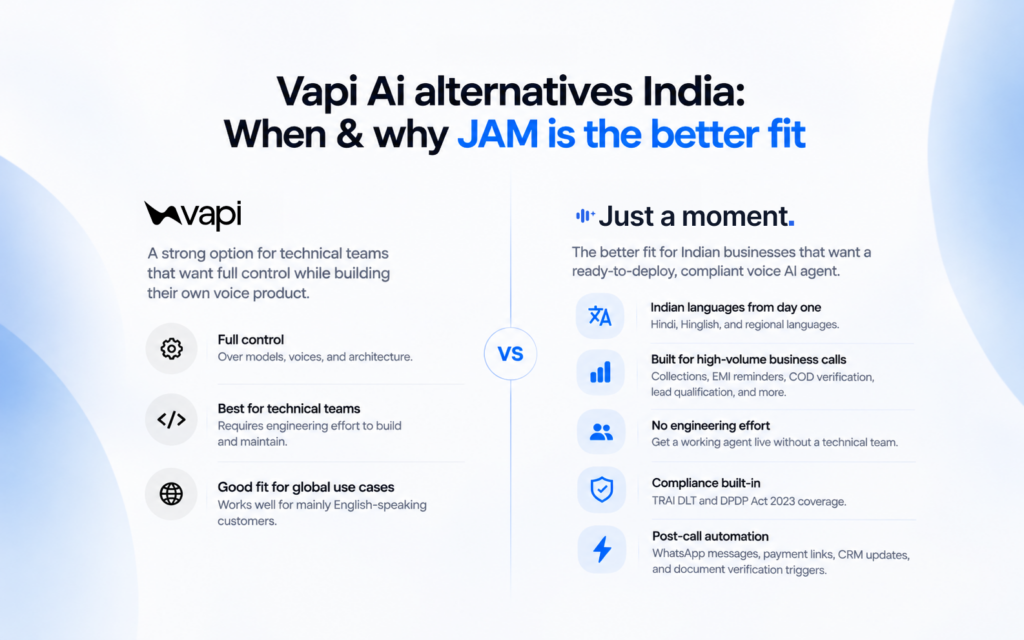
Many teams search for Vapi AI alternatives in India because they want something that works for Indian calls without a large engineering effort. Well, the JAM AI alternative to Vapi makes the most sense when:
- The business needs Hindi, Hinglish, and regional languages from day one.
- Calls are high volume, like collections, EMI reminders, COD verification, or lead qualification.
- The team does not have engineers to build and maintain a custom agent.
- TRAI DLT and DPDP compliance need to be built in, not added later.
- The agent must trigger actions like WhatsApp messages, payment links, or CRM updates after the call.
When Vapi is still a good choice & what it does well
Vapi is a strong option when a technical team wants full control over models, voices, and architecture; is building a voice product of its own; or serves mainly global, English-speaking customers. In those cases, a Vapi AI alternative may not be needed at all.
So among Vapi AI alternatives in India, the right pick depends on how much the team wants to build versus how quickly it wants to go live.
JAM AI alternative to Vapi: How to compare & decide in 5 steps
Choosing a JAM AI alternative to Vapi, or sticking with Vapi, gets easier with a simple checklist.
- Map the call type: Support, sales, collections, or bookings.
- List the languages: Include Hinglish and regional languages customers actually use.
- Check team capacity: Decide whether in-house engineers will build and maintain the agent.
- Review compliance: Confirm TRAI DLT, consent, and DPDP handling.
- Run a pilot: Compare cost per resolved call, latency, and drop-offs on real calls.
Since you are now aware of how this voice AI platform comparison works, the decision usually becomes clear after a short pilot with real customers.
Conclusion
Since you are now aware of the Vapi vs JAM differences after this comparison of Vapi vs JAM, the choice comes down to who will build the agent and who the agent will talk to. Vapi suits technical teams that want full control and are ready to manage the stack. Well, for Indian businesses that need multilingual calls, built-in compliance, and quick deployment, the JAM AI voice agent is the more practical option. This JAM AI review shows that a JAM AI alternative to Vapi works best for Indian calling at scale. That’s why JAM is often the first name on the list of Vapi AI alternatives India.