Voice AI is now calling customers for EMI reminders, order confirmations, appointment bookings, insurance renewals, and support queries. But as more businesses put an AI agent on the phone, one question keeps coming up in every meeting: is voice AI safe?
The honest answer is that it depends on how the agent is built, what it is allowed to say and do, and which rules it follows. A voice agent that sounds natural is not automatically safe. Safe voice AI is one that protects customer data, stays within approved information, follows calling rules, and knows when to stop and hand the call to a human.
So if you are also wondering what safe voice AI means for your industry, this guide covers the security risks of AI voice, the voice AI guardrails that matter, voice AI compliance India rules like TRAI DLT and DPDP Act voice AI requirements, and what to check before choosing a vendor. Let’s get started!
What is safe voice AI & why it matters now
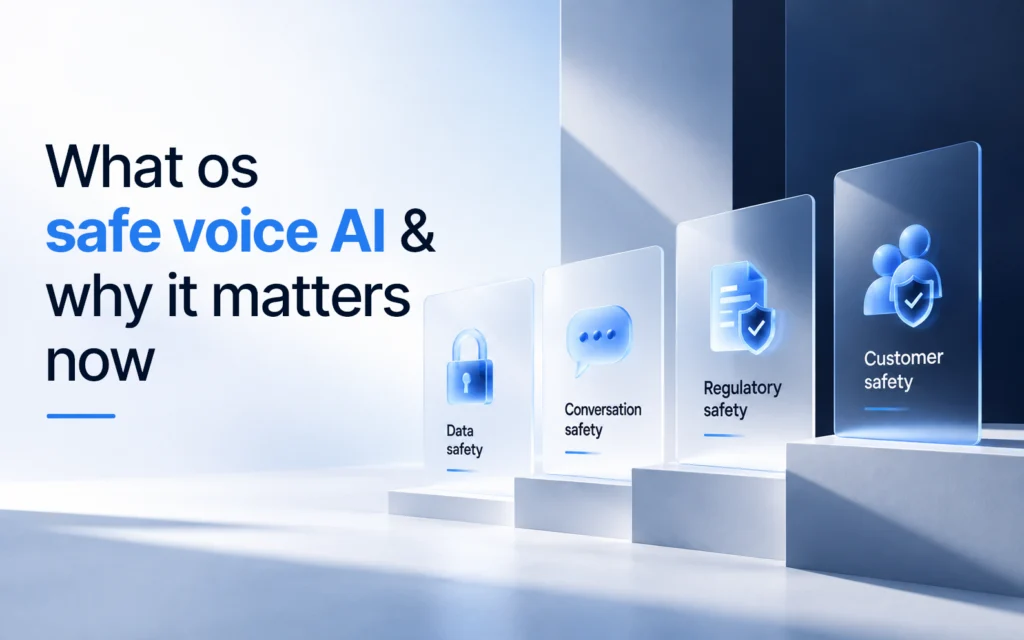
Here, what safe voice AI means is simple: an AI voice agent that can handle real customer calls without exposing data, giving wrong information, breaking calling rules, or putting the customer under pressure.
In practice, safe voice AI usually covers four things:
- Data safety: Customer data is collected only when needed, stored securely, and accessed only by approved systems.
- Conversation safety: The agent answers only from approved information and does not make up facts, offers, or promises.
- Regulatory safety: Calls follow TRAI rules, the DPDP Act, and the sector rules that apply to the business.
- Customer safety: Sensitive, angry, or vulnerable callers are moved to a trained human instead of being pushed by automation.
Did you know? In February 2024, the US Federal Communications Commission ruled that AI-generated voices in robocalls count as “artificial” voices under its telephone consumer protection law (SecurityInfoWatch).
That’s why safe voice AI is not only a technology question. It is a mix of good design, clear rules, and regular monitoring.
Is voice AI safe? Security risks of AI voice agents & how to reduce them
So, is voice AI safe? It can be, but only when the business understands the risks before going live. The security risks of AI voice are a little different from those of a website chatbot, because the agent is talking to real people in real time and often handling personal or financial information.
| Risk | What can happen | How to reduce it |
| Data leakage | The agent shares account or loan details with the wrong person | Verify identity before sharing any personal information |
| Hallucination | The agent makes up a due date, offer or policy | Restrict answers to approved data and knowledge sources |
| Prompt injection | A caller tries to trick the agent into ignoring its rules | Lock system instructions and limit what tools the agent can use |
| Voice cloning & impersonation | Fraudsters copy a voice or pretend to be the business | Use registered numbers, verify callers and avoid voice-only authentication |
| Unauthorised actions | The agent changes records or sends links it should not | Allow only defined, approved actions with clear limits |
| Insecure storage | Recordings and transcripts are exposed | Encrypt data, limit access and set retention periods |
Did you know? McAfee’s 2023 research found that just three seconds of audio can be enough to create a voice clone with around an 85% match to the original voice. That is one reason why voice alone should never be used to verify a customer (Business Wire).
Well, most of these security risks of AI voice can be controlled. The problem usually starts when a business launches an agent quickly without limits on what it can say, access, or do.
Voice AI guardrails & controls that make a secure AI voice agent
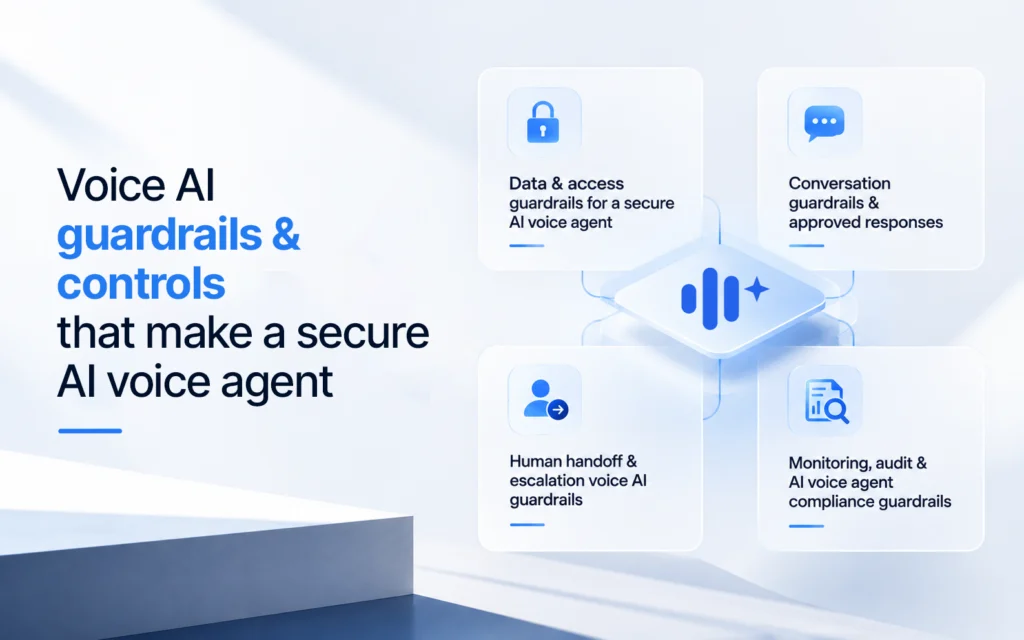
Voice AI guardrails are the rules and controls that keep an agent within safe limits during every call and reduce the security risks of AI voice. A secure AI voice agent usually needs guardrails at four levels.
Data & access guardrails for a secure AI voice agent
- Share personal details only after identity verification, such as a registered mobile number check or date of birth confirmation.
- Give the agent access only to the data it needs for that call type.
- Mask sensitive data like full account numbers, card numbers, and Aadhaar numbers in transcripts and logs.
- Encrypt recordings and transcripts, and delete them once the retention period ends.
Conversation guardrails & approved responses
- Answer only from approved scripts, policies, and knowledge sources.
- Avoid making promises about waivers, discounts, or approvals unless they are approved and available in the system.
- Identify the business clearly at the start of the call.
- Use polite, non-threatening language, especially in collections.
Human handoff & escalation voice AI guardrails
- Transfer the call when the customer raises a dispute, complaint, or hardship.
- Hand over when the customer asks for a human or sounds distressed.
- Pass the call summary and context so the customer does not have to repeat everything.
Monitoring, audit & AI voice agent compliance guardrails
- Keep call logs, outcomes, and consent records where required.
- Review a sample of calls regularly for accuracy and tone.
- Track escalation rates, complaints, and drop-offs to spot problems early.
And also, voice AI guardrails should be tested before launch by trying to break the agent: ask off-topic questions, interrupt it, give wrong details, and try to trick it into sharing data.
Voice AI compliance India: TRAI DLT, DPDP Act & sector rules
Voice AI compliance India is not covered by one single law. It is a combination of telecom rules, data protection law, and sector regulations. That’s why AI voice agent compliance has to be planned from day one.
TRAI DLT compliant AI calling & number series
TRAI’s Telecom Commercial Communications Customer Preference Regulations (TCCCPR), 2018, govern commercial calls and messages in India. TRAI DLT compliant AI calling means the business is registered on the Distributed Ledger Technology (DLT) platform, uses the right number series and respects customer preferences and consent.
| Number series | Used for |
| 140 series | Promotional and telemarketing calls |
| 160 series | Service and transactional calls by government bodies, regulators, and regulated financial entities such as banks, NBFCs, and insurers |
TRAI’s amendments to TCCCPR in February 2025 also stopped senders from using normal 10-digit numbers for telemarketing, introduced stricter penalties, and brought in disclosure of auto-dialer and robo calls. Here, what this means is simple: TRAI DLT compliant AI calling is not optional for businesses running commercial voice campaigns.
DPDP Act voice AI rules & call recordings
The Digital Personal Data Protection Act, 2023, applies to the personal data an AI voice agent collects, including recordings, transcripts, and call outcomes. The DPDP Act voice AI checklist usually includes:
- Notice & consent: Tell customers what data is collected and why, in clear language. The Act allows notice in English or any language listed in the Eighth Schedule.
- Purpose limitation: Use call data only for the stated purpose.
- Security safeguards: Protect data with reasonable security measures. Failure to do so can attract a penalty of up to ₹250 crore.
- Breach reporting: Report personal data breaches to the Data Protection Board and affected customers as the rules require.
- Retention & erasure: Delete data when it is no longer needed.
The DPDP Rules, 2025 were notified in November 2025, and most operational obligations are expected to apply from 13 May 2027. So the DPDP Act voice AI work should start now, not in 2027.
RBI, IRDAI & sector rules that shape voice AI compliance India
- NBFCs & banks: RBI guidance says recovery agents should not call borrowers before 8 am or after 7 pm and should not use intimidation or harassment. Outsourcing does not reduce the regulated entity’s responsibility.
- Insurance: Insurers and intermediaries need to follow IRDAI’s rules on distance selling and telemarketing.
- Healthcare: Patient information is highly sensitive, so calls should avoid sharing medical details without proper verification.
Safe voice AI for industry: Risks & controls by sector
Safe voice AI for industry is not one fixed checklist. Each sector has its own risks, so safe voice AI for industry has to match the calls a business actually makes.
| Industry | What “safe” means on a call | Key controls |
| NBFC & lending | Respectful reminders, accurate dues, no harassment | RBI calling hours, approved scripts, dispute escalation |
| Banking | No data leakage, strong verification | Identity checks, 160 series, masked data |
| Insurance | Clear disclosures, no mis-selling | Approved product information, consent records |
| Healthcare | Patient privacy, no medical advice | Verification, appointment-only scope, quick handoff |
| eCommerce & D2C | Correct order data, safe payment links | COD verification scripts, secure links, OMS access limits |
| Real estate & edtech | Consent for promotional calls | 140 series, DLT registration, opt-out handling |
Since you are now aware of how safe voice AI for industry changes by sector, the next step is choosing a vendor that can actually support these controls.
How to check AI voice agent compliance & vendor security
Many businesses check voice quality first and compliance last. It should be the other way round. AI voice agent compliance questions to ask any vendor:
- Is the platform built for TRAI DLT compliant AI calling, with support for 140 and 160 series numbers?
- How does the platform handle consent, notice, and DPDP Act voice AI requirements?
- Where are recordings and transcripts stored, and for how long?
- Is customer data used to train models?
- What voice AI guardrails are in place for identity checks, approved responses, and escalation?
- Are call logs, summaries, and audit trails available?
- How does the vendor test for the security risks of AI voice, such as prompt injection and data leakage?
A vendor that answers these clearly is far more likely to offer a secure AI voice agent than one that only talks about how human the voice sounds.
Why JAM is a secure AI voice agent for Indian calling & compliance
JAM is an enterprise voice AI platform built for high-volume, compliance-heavy Indian business environments. For businesses looking for safe voice AI for industry use:
- TRAI DLT compliant AI calling, RBI fair practices alignment, and DPDP Act 2023 coverage built into the platform
- Human handoff with full conversation context for sensitive or disputed calls
- Approved workflows and actions, such as CRM updates, WhatsApp messages, and payment links
- Call summaries and funnel analytics for monitoring and audits
- 12 Indian languages supported natively
So if your business wants a secure AI voice agent that follows Indian calling and data rules, JAM is where to start.
Conclusion
Since you are now aware of what safe voice AI means, it is clear that safety comes from design, not from the voice itself. Well, a business that sets strong voice AI guardrails, follows voice AI compliance India rules, and checks its vendor carefully can use AI calling with confidence. That’s why safe voice AI for industry is becoming a must-have rather than a nice-to-have.