Seventy per cent of routine business calls are now handled by AI. By the end of 2026, that number is expected to reach 80%.
If your enterprise is still staffing those calls manually, you are not just behind on technology. You are paying a cost your competitors have already eliminated.
This guide covers what AI voice agents actually are, how the technology works, what separates the best platforms from the rest, and where real businesses are already seeing measurable results.
Key takeaways
- AI voice agents handle natural, two-way phone conversations autonomously, without a human agent on the line
- The best AI voice agents go beyond call completion: they trigger post-call actions like CRM updates, payment links, and document verification
- Businesses using conversational voice AI report up to 90% reduction in per-call operational costs
- High-value use cases include collections, high-volume hiring, insurance, D2C support, and field service
- When evaluating the best AI voice agent platform, latency, language support, compliance, and post-call automation are the four critical differentiators
What are AI voice agents?
An AI voice agent is a software system that conducts natural, spoken conversations over the phone without any human involvement. It can handle inbound queries, run outbound calling campaigns, screen candidates, collect payments, and manage customer support at scale.
Unlike the rigid phone trees of traditional IVR systems, modern AI voice agent technology is powered by large language models that understand context, handle interruptions gracefully, track multi-topic conversations, and adapt to what the caller actually says in real time.
The result is a system that does not just answer calls. It completes them, and then completes the workflow that follows.
How AI voice agent technology works
Understanding what sits under the hood helps businesses make sharper buying decisions. A production-ready AI voice agent runs on four core components.
Automatic Speech Recognition (ASR) converts spoken words into text in real time. Enterprise-grade systems achieve latency under 300 milliseconds, fast enough to feel like a genuine conversation rather than a lagging call.
Large Language Model (LLM) processes the transcribed text and generates a contextually appropriate response based on intent, conversation history, and the caller’s most recent statement. This is where intelligence lives: the ability to handle unexpected questions, manage objections, and carry context across a lengthy call without losing the thread.
Text-to-Speech (TTS) converts the agent’s response back into audio. Leading conversational AI platforms use neural TTS and voice cloning to produce speech that is difficult to distinguish from a trained human agent.
The action layer is where conversational voice AI becomes genuinely operational. Once a call concludes, the action layer triggers the next step in the workflow automatically: a payment link sent via WhatsApp, a support ticket raised in the CRM, a verification document requested, or a candidate follow-up form delivered. Most platforms handle the first three layers reasonably well. The action layer is where the best AI voice agents differentiate themselves.
AI voice agents vs IVR vs chatbots: what is the difference?
These three terms are often used interchangeably. They should not be.
IVR (Interactive Voice Response) is the “press 1 for billing, press 2 for support” system most consumers dread. It follows a rigid, pre-defined script and has no ability to understand natural language, manage interruptions, or handle any response it was not programmed for.
Chatbots are text-based systems designed for web and messaging interfaces. They are not built for real-time voice. They lack the speech processing architecture, noise tolerance, and latency management that telephone conversations demand.
AI voice agents conduct real-time, natural spoken conversations. They understand intent, switch between topics mid-call, handle interruptions without confusion, detect silence, filter background noise, and trigger post-call actions. They are the only system of the three that can genuinely replace a human telephone agent at scale, around the clock.
The shift from legacy IVR to a conversational AI platform is not a technology upgrade. It is a category change.
Core capabilities of the best AI voice agents
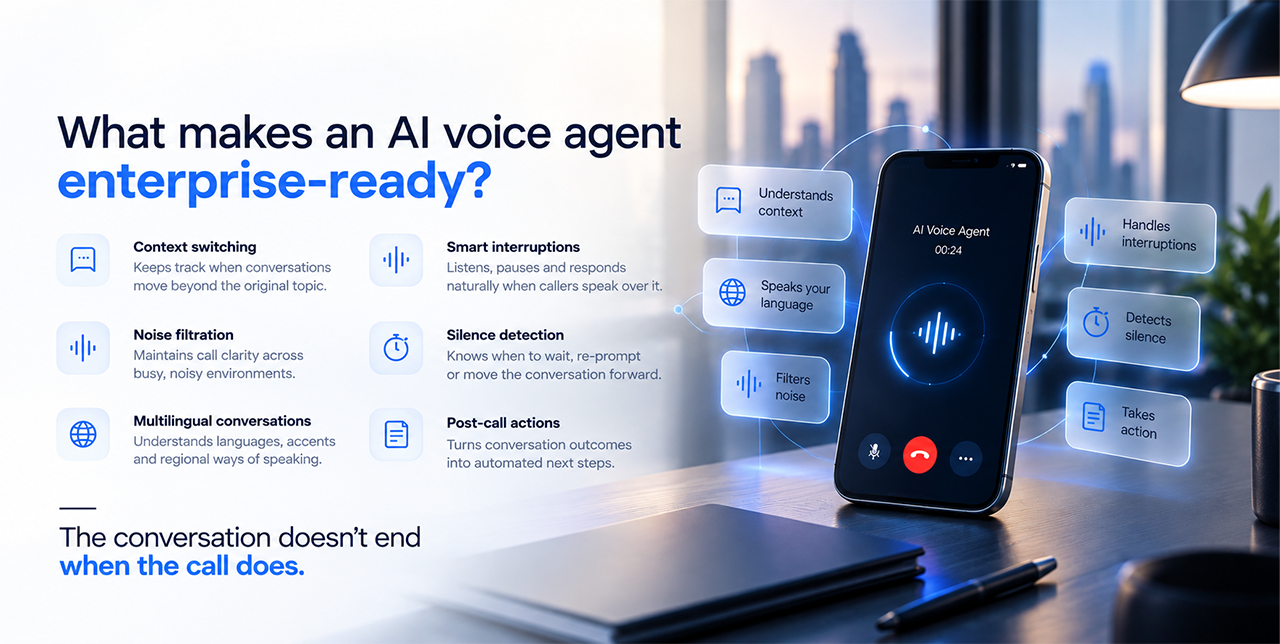
Enterprise-grade platforms share a set of capabilities that consumer or mid-market tools do not reliably offer.
Context switching: A borrower mentions their loan, then pivots to ask about their repayment schedule. A capable AI voice agent tracks both without losing the thread. Inferior systems break the moment a conversation departs from the pre-built flow.
Smart interruptions: Real conversations are unscripted. People talk over the agent, correct themselves, and change their mind mid-sentence. The best AI voice agents handle interruptions naturally, pausing, listening, and resuming without confusion or repetition.
Noise filtration: A driver taking a recruitment call from a busy highway, or a borrower calling from a crowded home — background noise degrades transcription accuracy and call quality. Enterprise platforms filter ambient noise in real time to maintain accuracy across diverse calling environments.
Silence detection: When a caller stops responding, the system needs to determine whether to wait, re-prompt, or close the call. Intelligent silence detection reduces wasted call time and improves completion rates.
Multilingual support: In markets like India, a single outbound campaign may need to reach people in Hindi, Marathi, Kannada, and Assamese simultaneously. The best AI voice agent platforms support multiple languages natively, not as a feature add-on, but as core infrastructure. Native language support also means accurate recognition of regional accents and colloquialisms, which matters significantly in practice.
Post-call custom actions: This is the most undervalued capability in most evaluations. When a call ends with a specific outcome, the platform triggers the next step automatically, with no human handoff and no delay. This is what transforms AI voice agents for business from a call-handling tool into an end-to-end operations layer.
AI voice agents for business: real use cases
Lending and collections
Mufin Green Finance, an EV lending company, faced a familiar collections challenge: reaching thousands of borrowers at scale without growing the agent team proportionally.
They deployed a conversational voice AI platform with multilingual capability across Hindi and Assamese. The results were direct: a 78% call pick rate, a 40% reduction in collections costs, and Rs 2 crore in incremental collections.
The platform did not simply dial numbers. It tracked conversation outcomes, identified intent to pay, and triggered follow-up actions automatically based on what the borrower said on the call.
High-volume hiring
WTI Cabs needed to recruit drivers at scale across pan-India, in Hindi, Marathi, and Kannada simultaneously. Manual screening at that volume is not feasible without a large, expensive recruiting team.
They deployed an AI voice agent to handle first-stage screening and candidate follow-ups. When a candidate qualified, a WhatsApp message with the next step was sent within seconds of the call ending. The outcome: a 63% call pick rate, a 25% reduction in recruitment costs, and a 7% placement success rate across thousands of weekly calls.
The speed of that post-call follow-up was significant. When candidates receive a form within seconds of qualifying, drop-off rates fall sharply compared with a follow-up that arrives the next morning.
Insurance
Outbound insurance calls face two compounding problems: low pick rates and slow post-call processing. When a prospect agrees to proceed, the next step — document collection and identity verification — often waits 24 to 48 hours.
AI voice agents compress that window. The moment a call closes positively, the verification workflow is triggered: the prospect receives a document link and the ops team receives a pre-populated case. Processing time shrinks from days to hours.
D2C and customer support
A customer calls about a wrong delivery. The AI voice agent manages the conversation. Post-call, a CRM ticket is created automatically, populated with the caller’s name, order ID, issue description, and a structured call summary. The support team opens a complete case, not a blank one.
The impact extends beyond cost reduction. It is resolution speed and the customer satisfaction that follows.
What separates the best AI voice agent platform from the rest
Businesses evaluating conversational AI platforms in 2026 are not short of options. The differentiating factors come down to five things.
Latency: Sub-300 millisecond response time is the threshold for natural conversation. Above it, callers notice the gap and the interaction begins to feel robotic. Treat this as a baseline requirement, not a premium feature.
Language support: For businesses operating in multilingual markets, language capability is infrastructure. Native support for regional languages, not just English, is non-negotiable. Evaluate whether the platform supports the specific languages and accents your callers actually use.
Compliance: In regulated industries such as lending, insurance, and healthcare, the platform must meet applicable standards. In India, this includes TRAI guidelines, RBI communication norms for lending operations, and the DPDP Act 2023 for data privacy. A platform that cannot demonstrate compliance is a liability, not an asset.
Post-call automation depth: Evaluate whether the platform can trigger CRM updates, WhatsApp messages, payment links, document verification, and knowledge base entries automatically, or whether those steps still require a human handoff after every call.
Deployment speed: Enterprise voice deployments that take months to go live create meaningful risk and delay ROI. The best AI voice agent platforms deploy in days for standard configurations, adapting to your existing workflows rather than requiring workflows to rebuild around the platform.
How to evaluate a conversational AI platform
When shortlisting AI voice agents for business, use this framework.
- Conversation quality: Run a live demo with real-world scenarios from your industry. Test how the system handles interruptions, unexpected questions, and multi-topic conversations.
- Language and dialect accuracy: Does the platform natively support the specific languages and regional accents your callers use?
- Integration depth: How does the platform connect to your CRM, payment gateway, ticketing system, and WhatsApp Business API?
- Analytics capability: Can you access call-level data, completion rates, sentiment trends, and funnel drop-off analysis?
- Compliance documentation: Can the vendor provide compliance certifications relevant to your regulatory environment?
- Pilot timeline: How quickly can a pilot go live? A few days signals a mature, configurable platform. Several months signals a product still being adapted around your use case.
Conclusion
AI voice agents in 2026 are not a pilot programme. They are operational infrastructure — the layer between your business and the millions of conversations it needs to have every year, at scale, without scaling headcount proportionally.
The technology is mature. The ROI is documented. The gap between businesses that have deployed conversational voice AI and those still running manual calling operations is widening every quarter.
The question is not whether AI voice agents are right for your enterprise. The question is which platform is right, and how quickly you can get it live.
JAM by Just a moment is an enterprise voice AI platform built for high-volume operations: collections, hiring, support, insurance, and beyond. It deploys in a few days, supports 12 Indian languages natively, and goes beyond completing calls to completing the workflows that follow.
See how JAM works at Justamoment.ai