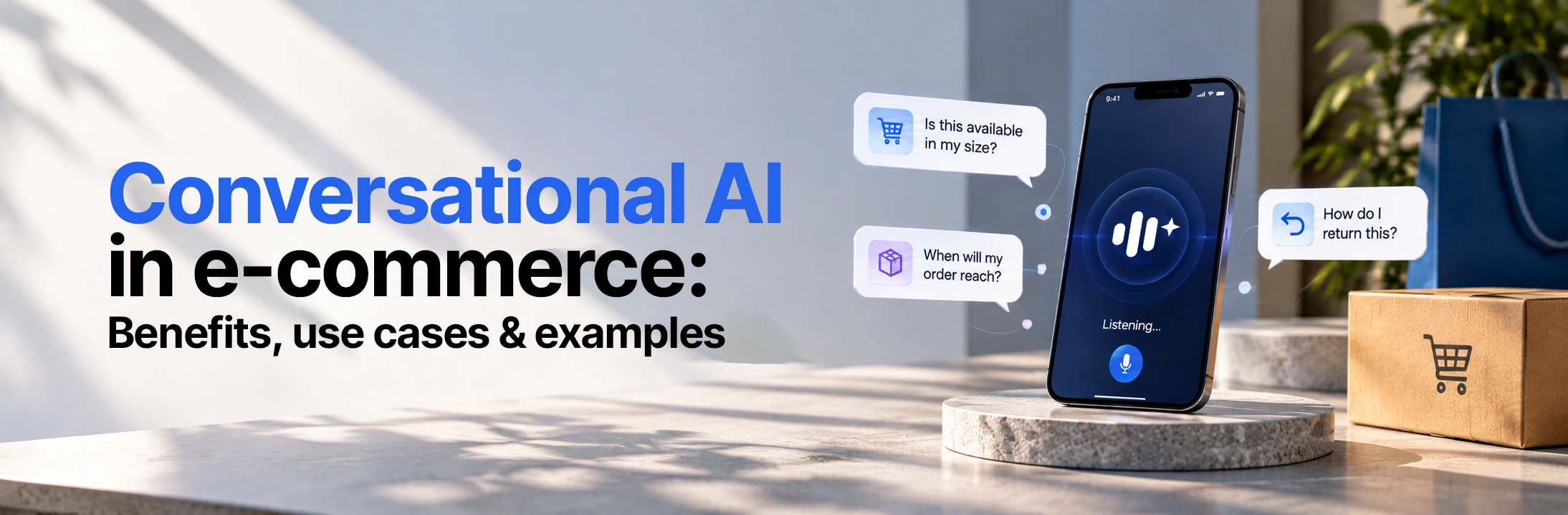
Online shoppers ask a lot of questions before and after they buy. Is this available in my size? When will my order reach? Earlier, all of these questions went to a support team, and customers had to wait for an answer.
That’s why conversational AI in e-commerce is now becoming a normal part of how online stores sell and support customers. It lets shoppers ask questions in their own words, over chat, WhatsApp or a phone call, and get an answer right away.
So if you are new to what conversational AI in ecommerce actually does, this guide explains how conversational AI works in ecommerce, the benefits, the most useful use cases, and some real examples of conversational AI in e-commerce from brands that already use it.
What conversational AI in ecommerce means & why it matters
Here, what conversational AI in ecommerce means is simple: it is technology that understands what a customer is saying or typing, figures out what they need, and replies like a real conversation. It can also take an action, like checking an order status or creating a return request.
It usually works on two main channels:
- Chat: An AI chatbot for ecommerce on the website, app, or WhatsApp.
- Voice: AI agents on inbound and outbound phone calls.
Conversational AI for ecommerce helps brands answer the same questions again and again without adding more people to the support team. And also, it keeps the store “open” at night, on Sundays and during big sale days when call and chat volumes go up suddenly.
Conversational AI vs chatbot: What is the difference & which one fits
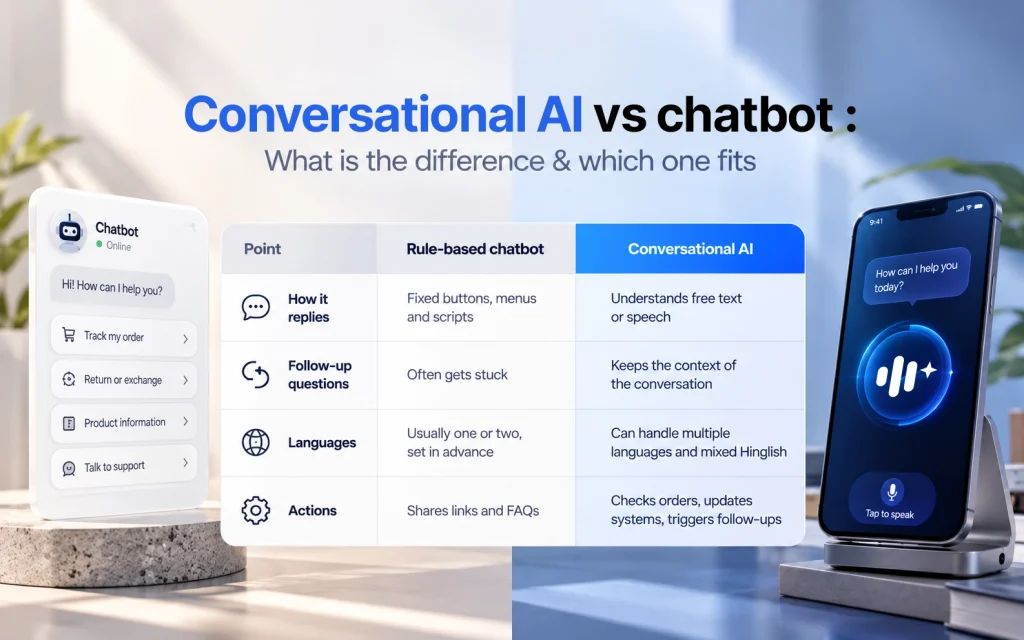
A lot of people use these two terms as if they mean the same thing, but they don’t. The conversational AI vs chatbot question comes down to how much the system can understand and do.Well, an old-style AI chatbot for ecommerce still works for very simple FAQs. But when
| Point | Rule-based chatbot | Conversational AI |
| How it replies | Fixed buttons, menus and scripts | Understands free text or speech |
| Follow-up questions | Often gets stuck | Keeps the context of the conversation |
| Languages | Usually one or two, set in advance | Can handle multiple languages and mixed Hinglish |
| Actions | Shares links and FAQs | Checks orders, updates systems, triggers follow-ups |
customers ask questions in their own way, change the topic or switch from English to Hindi, the conversational AI vs chatbot difference becomes very clear.
How conversational AI works in ecommerce: Steps & systems involved
To understand how conversational AI works in ecommerce, think of one simple question like “Mera order kahan hai?” and follow what happens next.
| Step | What happens in the background |
| 1. Input | The customer types a message or speaks on a call |
| 2. Understanding | Speech recognition (for voice) and language models understand the intent |
| 3. Data check | The system pulls order details from the store, OMS or courier partner |
| 4. Reply | It answers in text or a natural voice, in the customer’s language |
| 5. Action | It updates the system, sends a WhatsApp link or schedules a callback |
| 6. Handoff | Complex cases go to a human agent with the full context |
So how conversational AI works in ecommerce is not very different from how a good support agent works. It listens, checks the details, answers and moves the request forward. The only difference is that it can do this for thousands of customers at the same time.
Benefits of conversational AI for e-commerce brands & shoppers
The benefits of conversational AI for e-commerce show up on both sides: the customer gets faster help, and the brand saves time and money.
- Instant answers: Customers do not have to wait in a queue for basic questions.
- 24/7 support: Help is available outside working hours and during sale spikes.
- Lower support cost: Repeated questions move to an automated layer, which is one of the biggest benefits of conversational AI for e-commerce teams.
- More sales: Product questions get answered at the moment the shopper is deciding, and brands increase ecommerce conversions with voice AI by calling shoppers at the right time.
- Fewer RTOs: COD orders get confirmed before dispatch.
- Regional language support: Shoppers can talk in Hindi, Hinglish or their own language.
Did you know? Baymard Institute estimates that around 70% of online shopping carts are abandoned before checkout. Even a small recovery from that number can make a big difference to revenue.
Since you are now aware of the benefits of conversational AI for e-commerce, it is also important to know that these benefits depend on setup. A system that is not connected to order data or that gives wrong answers can frustrate customers instead of helping them.
Conversational AI use cases in ecommerce: Chat, voice & WhatsApp
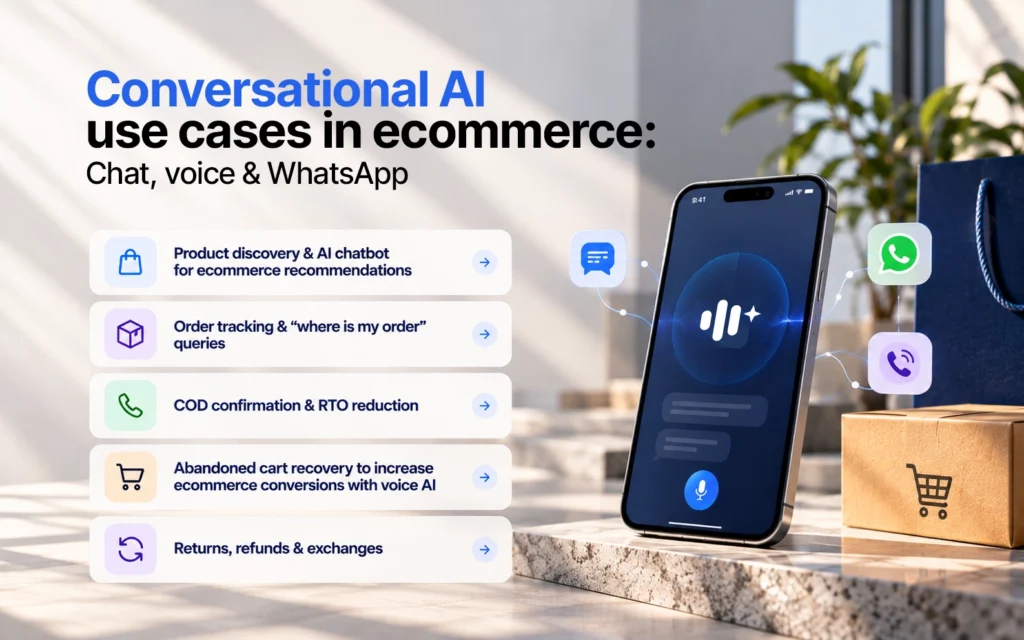
There are many conversational AI use cases in ecommerce, but a few of them give results much faster than others.
Product discovery & AI chatbot for ecommerce recommendations
An AI chatbot for ecommerce can help shoppers find the right product by asking simple questions like budget, size, skin type or occasion. This feels closer to talking to a store assistant than scrolling through hundreds of products.
Order tracking & “where is my order” queries
“Where is my order?” is one of the most common questions any online store gets. Conversational AI for ecommerce helps by fetching live tracking data and giving the customer the status, expected date and reason for delay in a few seconds.
COD confirmation & RTO reduction
For Indian brands, this is one of the most valuable conversational AI use cases in ecommerce. A voice agent calls the customer soon after a cash on delivery order, confirms the address and intent, and offers a prepaid payment link. Fake or unwanted orders get flagged before dispatch.
Abandoned cart recovery to increase ecommerce conversions with voice AI
A WhatsApp nudge or a short call can remind the shopper about the items left in the cart and answer the question that stopped them, like delivery time or return policy. Many brands use this to increase ecommerce conversions with voice AI, especially for high-value products.
Returns, refunds & exchanges
Conversational AI for ecommerce helps here too. It can register a return, check eligibility, book a pickup, and tell the customer when the refund will be credited. This removes a lot of repeat calls.
Examples of conversational AI in e-commerce from Indian & global brands
Looking at real examples of conversational AI in e-commerce makes it easier to see what is possible. Here are a few well-known examples of conversational AI in e-commerce:
| Brand | What they built | What was reported |
| Meesho | A generative AI voice bot for customer support in Hindi and English, launched in 2024 | Handles around 60,000 calls a day, with the company claiming a 95% resolution rate and up to 75% lower cost on some calls |
| Amazon | Rufus, a generative AI shopping assistant inside the Amazon app, also launched in India in 2024 | Answers product questions, compares items and gives suggestions |
| Sephora | One of the early beauty chatbots, launched on the Kik messaging app in 2016 | Shared beauty tips and product suggestions through chat |
These examples of conversational AI in e-commerce show one clear pattern: brands start with one of the conversational AI use cases in ecommerce that has high volume, like support calls or product questions, and then expand.
AI voice agents for e-commerce & why voice matters in India
Most conversations about AI in online shopping focus on chat. But the conversational AI vs chatbot debate is not only about text. AI voice agents for e-commerce are becoming just as important, especially in India.
Why voice works for Indian shoppers & regional languages
- Many shoppers find it easier to speak than to type, especially in their own language.
- According to the 2011 Census, Hindi is spoken by about 43.6% of India’s population, and many others prefer regional languages.
- Outbound calls suit conversational AI use cases in ecommerce like COD confirmation, failed deliveries and payment reminders.
How AI voice agents for e-commerce recover orders & increase ecommerce conversions with voice AI
AI voice agents for e-commerce can call shoppers who abandoned a cart, confirm COD orders before dispatch and follow up on failed deliveries. Conversational AI for ecommerce helps save orders that would otherwise be lost. That is how brands increase ecommerce conversions with voice AI without spending more on ads.
And also, AI voice agents for e-commerce can handle inbound calls for order tracking, returns and refunds, so human agents get more time for complaints and high-value customers.
KPIs & metrics to track for conversational AI in e-commerce
It is easy to launch a bot and forget about it. That’s why tracking the right numbers matters, because the benefits of conversational AI for e-commerce only count when they show up in data.
| KPI | What it shows |
| Resolution rate | How many conversations end without a human |
| Handoff rate | How often the AI needs to pass the case to a person |
| CSAT score | How happy customers are after the conversation |
| COD confirmation rate | How many COD orders get confirmed or cancelled before dispatch |
| Cart recovery rate | Whether efforts to increase ecommerce conversions with voice AI and chat are working |
| Cost per resolved query | How much each solved conversation costs |
How to choose conversational AI for small & large ecommerce brands
What conversational AI in ecommerce can do for a small brand is a bit different from what it does for a large marketplace. A small team usually needs quick setup and ready integrations, while a bigger brand needs scale, analytics and custom workflows. The conversational AI vs chatbot choice also matters here, because a store with only simple FAQs may manage with a basic chatbot at first.
- Start with one use case: Among all conversational AI use cases in ecommerce, order tracking or COD confirmation usually shows results quickest.
- Check integrations: Shopify, WooCommerce, custom OMS, courier partners and WhatsApp.
- Test real conversations: Use Hinglish, interrupt the bot and ask unexpected questions.
- Check human handoff: Complex cases should reach a person with full context.
- Look at pricing clearly: Check per-conversation or per-minute cost, telephony and setup charges.
Why JAM is built for AI voice agents for e-commerce & Indian languages
JAM is an enterprise voice AI platform built for high-volume Indian businesses. For online brands specifically:
- COD verification, order tracking and failed delivery calls run automatically at scale
- 12 Indian languages supported natively, including Hindi, Marathi, Tamil and Kannada
- Custom actions fire post-call: WhatsApp messages, payment links and CRM or OMS updates
- TRAI DLT compliance and DPDP Act 2023 coverage built into the platform
So if your brand wants to join the growing examples of conversational AI in e-commerce over voice, JAM is a good place to start.
Conclusion & key takeaways
Since you are now aware of what conversational AI in ecommerce is, how conversational AI works in ecommerce and where it fits, the next step is simple: pick one high-volume task and start there, because the benefits of conversational AI for e-commerce show up fastest that way. Well, conversational AI for ecommerce helps brands answer faster, confirm more orders and recover more carts, while human teams focus on the conversations that need care. That’s why more online brands are adding both chat and voice to their customer journey.