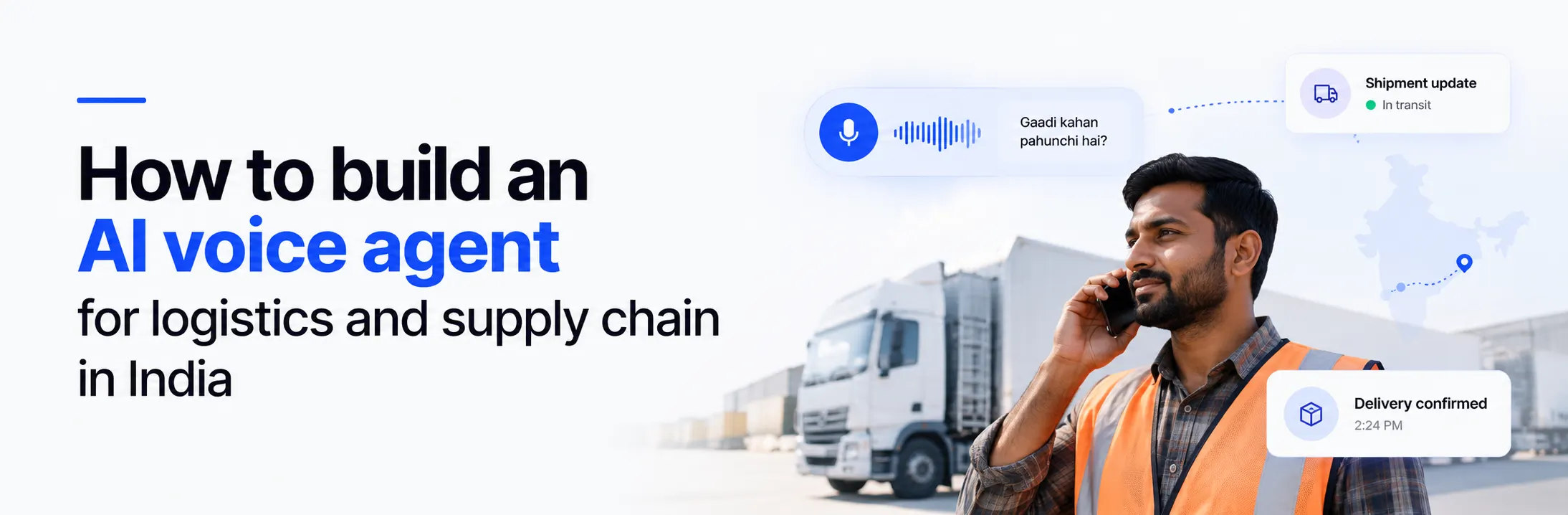
Logistics in India runs on phone calls. Dispatchers call drivers to check where the truck is, customers call to ask about their shipment, warehouse teams call to confirm slots, and transporters call to confirm loads. A lot of this work happens over the phone, and most of it is the same few questions asked again and again.
That’s why more companies are now looking at an AI voice agent for logistics in India. It can take routine calls off the team’s plate, talk to drivers and customers in their own language, and update the right system after every call.
So if you are new to this, this guide explains what a logistics voice agent does, how voice AI handles logistics operations, which systems it needs, and how to build one step by step.
Why logistics voice automation matters for Indian shippers & transporters
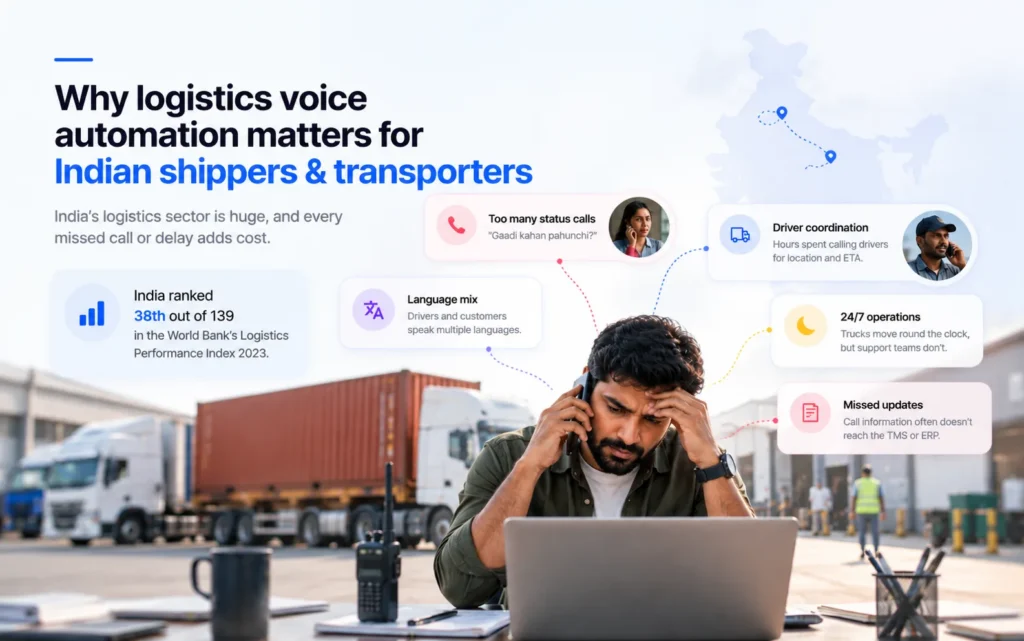
India’s logistics sector is huge, and every small delay or missed call adds cost.
Did you know? India climbed six places to rank 38th out of 139 countries in the World Bank’s Logistics Performance Index 2023. (Source: DT Next)
Even with better roads and digital systems, a lot of daily coordination still happens over calls. Here, what this means is simple: logistics voice automation can save hours of manual calling every day.
- Too many status calls: Customers and partners keep calling to ask “Gaadi kahan pahunchi?”
- Driver coordination: Dispatchers spend hours calling drivers for location, ETA, and proof of delivery.
- Language mix: Drivers and customers speak Hindi, Marathi, Tamil, Telugu, Punjabi, and many other languages.
- Night and weekend gaps: Trucks move 24/7, but support teams do not.
- Missed updates: Information shared on calls often does not reach the TMS or ERP on time.
What an AI voice agent for logistics and transport does & which calls it handles
Here, what an AI voice agent for logistics and transport means is simple: it is software that makes and answers phone calls, understands what the person says, checks or updates the right system, and then takes the next step.
| Call type | What the agent does |
| Driver check-in calls | Asks for location, ETA, delays, and issues on the road |
| Delivery confirmation | Confirms delivery, captures POD status, and flags damage |
| Customer shipment queries | Shares live status and expected delivery date |
| Pickup scheduling | Confirms pickup slots with vendors and warehouses |
| Failed delivery follow-ups | Collects a new address or time slot for reattempt |
| Payment & COD reminders | Reminds customers or partners about pending payments |
Well, the same AI voice agent for logistics and transport can work for inbound calls, like a customer asking for an update, and outbound calls, like checking on 500 drivers at the start of a shift.
How voice AI handles logistics operations: Steps & call flow
To understand how voice AI handles logistics operations, follow one simple driver check-in call.
| Step | What happens |
| 1. Trigger | The TMS shows a truck is due at a checkpoint, and the agent calls the driver |
| 2. Conversation | The agent asks, “Aap abhi kahan hain? Kitne baje tak pahunchoge?” |
| 3. Understanding | Speech recognition and the language model understand the reply, even in Hinglish |
| 4. System update | The location, ETA and any issue go into the TMS |
| 5. Alert | If there is a breakdown or a big delay, the dispatcher gets an alert |
| 6. Customer update | The customer gets a WhatsApp or call with the new ETA |
So how voice AI handles logistics operations is very close to how a good dispatcher works. It asks the right questions, notes the answers, and tells the right people. The difference is that it can do this for hundreds of trucks at the same time.
AI dispatch calls & driver calling automation
AI dispatch calls are one of the most useful parts of this setup. With driver calling automation, the agent can call every driver at fixed times, collect updates, and push them into the system. Dispatchers then spend their time on exceptions, like breakdowns, route problems, or upset customers, instead of making routine calls.
Driver calling automation & AI dispatch calls in a typical shift
| Time | What the agent does |
| Start of shift | AI dispatch calls confirm the driver, vehicle, and route. |
| Midway | Driver calling automation to check the location, ETA, and fuel or toll issues. |
| Near delivery | The agent confirms the unloading slot with the warehouse. |
| After delivery | The agent confirms POD and flags any damage or shortage. |
Here, what this means is simple: driver calling automation covers the routine check-ins, while AI dispatch calls keep the dispatcher informed without anyone dialling manually.
Data & systems a supply chain AI voice agent needs
A supply chain AI voice agent is only as good as the data it can reach, because how voice AI handles logistics operations depends on live system data. Without system access, it can talk but cannot really help.
| System | What the agent uses it for |
| TMS (transport management system) | Trip status, vehicle details, ETAs, driver contacts |
| WMS (warehouse management system) | Stock, slot bookings, dispatch readiness |
| ERP (like SAP or Odoo) | Orders, invoices, customer and vendor records |
| CRM | Customer history, tickets and follow-ups |
| GPS or telematics | Live vehicle location to cross-check driver updates |
| WhatsApp & SMS | Sending links, ETAs and confirmations after the call |
Here, what this means is simple: the supply chain AI voice agent should read only the data it needs and write back only the updates it is allowed to make.
How to build an AI voice agent for logistics in India: Steps & checklist
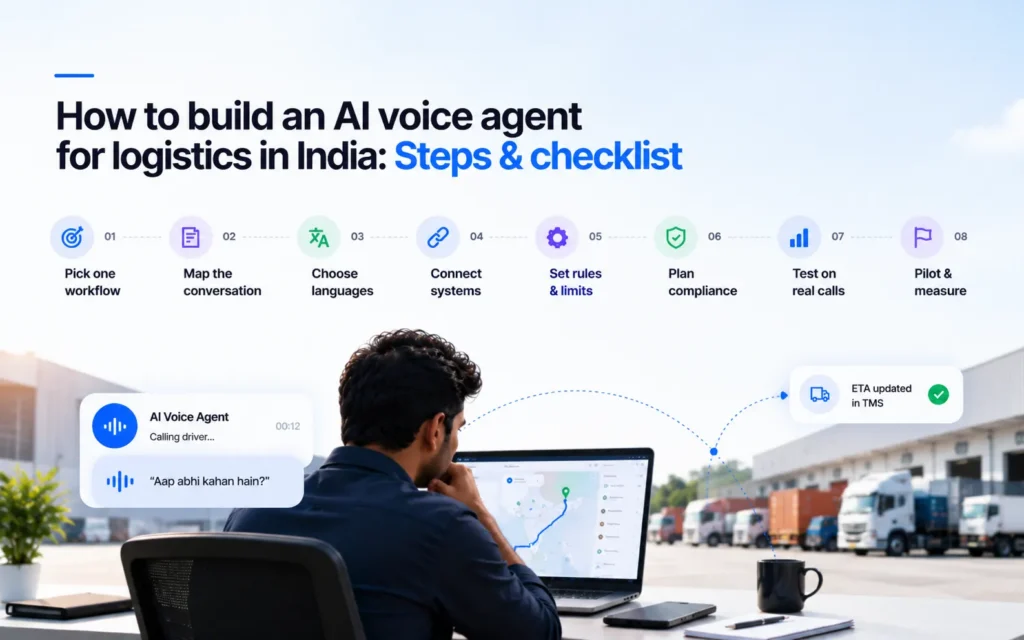
Building an AI voice agent for logistics in India gets much easier when the work is broken into clear steps.
- Pick one workflow: Start with driver check-ins, shipment status calls, or delivery confirmations.
- Map the conversation: Write the questions, possible answers, and what happens after each one.
- Choose languages: List the languages drivers and customers actually use on each route.
- Connect systems: Link the TMS, WMS, ERP, or CRM through APIs so the agent can read and update data.
- Set rules & limits: Decide what the agent can do alone and what must go to a human.
- Plan compliance: Cover consent, data security, and TRAI rules for outbound calls.
- Test on real calls: Try noisy highways, weak networks, Hinglish, and interruptions.
- Pilot & measure: Run a small pilot and track answer rates, accuracy, and dispatcher time saved.
And also, the agent should keep improving. Reviewing a sample of calls every week helps fix wrong answers and confusing questions. That is what separates the best AI voice agent for logistics from an average one.
AI customer support voice bot for logistics & customer calls
An AI customer support voice bot for logistics handles the calls that usually flood the support desk.
- “Mera shipment kab aayega?”
- “Delivery boy ne call nahi kiya.”
- “Address change karna hai.”
- “Return pickup kab hogi?”
The AI customer support voice bot for logistics checks the system, shares the right update, and creates a ticket if needed. Complaints about damage, lost shipments, or billing disputes go to a human with the full context.
Benefits of logistics voice automation for supply chain & support teams
The benefits of logistics voice automation show up across operations, support, and cost for any supply chain AI voice agent.
- Fewer manual calls: Dispatchers and support teams stop making the same calls all day.
- Faster updates: Driver and shipment updates reach the system in minutes, and an AI customer support voice bot for logistics answers customers instantly.
- Better visibility: Managers can see delays and issues across all trips.
- 24/7 coverage: Calls continue at night, on Sundays, and during peak season.
- Multilingual reach: Drivers and customers speak in the language they are comfortable with.
- Cleaner data: Every call outcome is captured in a structured way.
Since you are now aware of these benefits, it is also important to remember that the agent works best when it supports people, not replaces their judgement.
How to choose the best AI voice agent for logistics & what to check
Choosing the best AI voice agent for logistics becomes easier with a simple checklist for any AI voice agent for logistics and transport.
| What to check | Why it matters |
| Indian language support | Drivers and customers speak many languages and mix them |
| Noise handling | Calls often happen on highways and in busy warehouses |
| System integrations | TMS, WMS, ERP and CRM updates should be automatic |
| Human handoff | Breakdowns, accidents and disputes need a person quickly |
| Compliance | TRAI rules, consent and DPDP data safeguards |
| Analytics | Answer rates, delays flagged and time saved |
So the best AI voice agent for logistics is the one that works on real Indian roads and real Indian phone lines, not just in a demo.
Why JAM fits as an AI voice agent for logistics in India & supply chain teams
JAM is an enterprise voice AI platform built for high-volume Indian business environments. It can work as an AI customer support voice bot for logistics and a driver calling tool. For logistics and supply chain teams, it offers:
- 12 Indian languages supported natively, including Hindi, Marathi, Tamil, Kannada, and Assamese
- AI dispatch calls and driver calling automation for check-ins and ETAs
- Context switching and interruption handling during live calls
- Post-call actions such as WhatsApp messages, CRM updates, and custom workflow triggers
- Call funnel analytics with drop-off points and resolution rates
- TRAI DLT compliance and DPDP Act 2023 coverage built into the platform
- Sub-300ms latency and deployment in a few days
So if your team is looking for the best AI voice agent for logistics in India, JAM is a good place to start.
Conclusion
Since you are now aware of how to build an AI voice agent for logistics in India, the next step is simple: pick one high-volume call type, connect it to your systems and run a pilot. Well, with the right setup, an AI voice agent for logistics and transport and logistics voice automation can save hours of calling every day and keep drivers, dispatchers and customers on the same page. That’s why more Indian companies are adding a supply chain AI voice agent to their operations.