Recruitment teams in India deal with huge numbers of applications. One job post for a sales executive, delivery partner, or customer support role can bring in hundreds of applicants in a few days. Someone then has to call each one, check basic details, and decide who moves ahead. Most of these first calls ask the same five or six questions again and again.
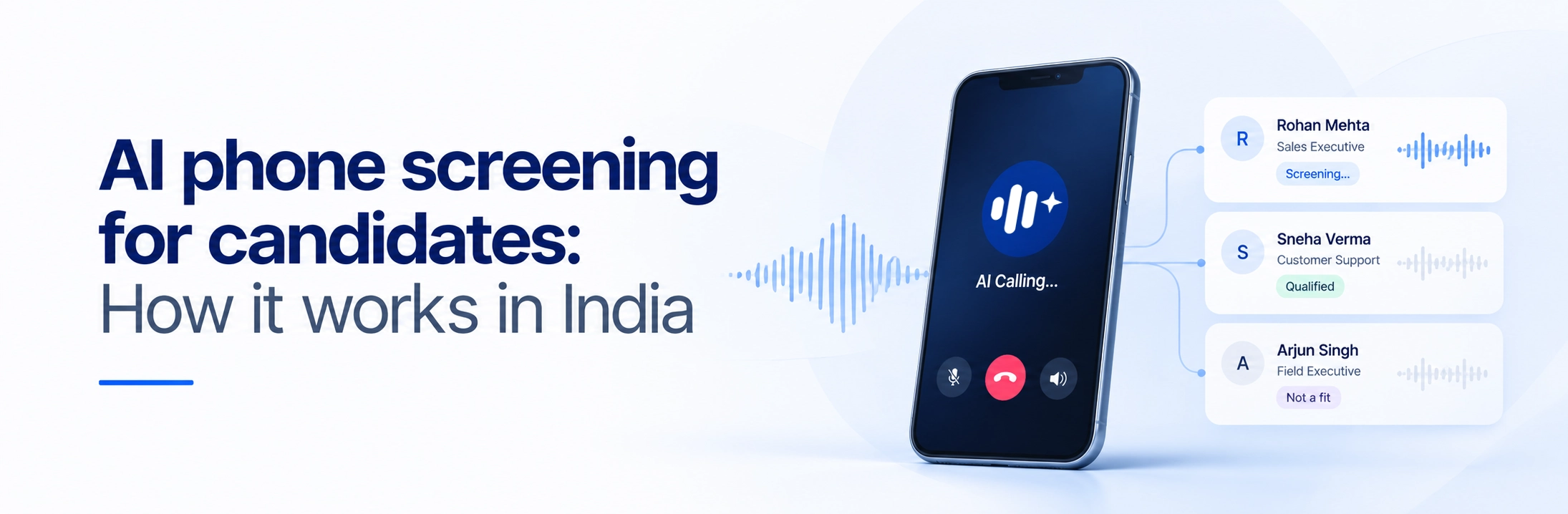
That’s why AI phone screening candidates is becoming a practical option for HR teams, staffing agencies, and BPOs. A voice AI agent can call every applicant within minutes, ask the screening questions in Hindi, English, or a regional language, and share a clear summary with the recruiter.
So if you are new to this, this guide explains how AI phone screening candidates works, where it fits in the hiring process, which rules apply in India, and what results teams can expect.
What is AI phone screening candidates & why it matters now
Here, what AI phone screening candidates means is simple: an AI agent makes the first screening call to a job applicant, asks a fixed set of job-related questions, records the answers, and scores the candidate based on rules set by the recruiter.
It replaces the first round of manual calling, not the full interview. The recruiter still takes the final call on who gets hired.
Did you know? SHRM data puts the average time to fill a position in the US at around 44 days. (Source: Toggl) A big part of that time goes into early stages like screening and scheduling, which is exactly where automated candidate screening calls help the most.
Well, speed matters in hiring too. Good candidates, especially for frontline roles, often apply to several companies at once, and the first company to call properly has a better chance of getting them.
How AI phone screening interview calls work: Steps & flow
An AI phone screening interview usually follows a simple flow:
| Step | What happens |
| 1. Application comes in | The candidate applies through a job portal, career page or referral |
| 2. Instant call | The voice AI agent calls the candidate within minutes, or at a time they choose |
| 3. Introduction & consent | The agent introduces the company, explains the call and asks if the candidate is free to talk |
| 4. Screening questions | The agent asks about experience, location, notice period, salary expectations and availability |
| 5. Scoring | Answers are checked against the recruiter’s must-have criteria |
| 6. Next step | Shortlisted candidates get an interview slot, others get a polite update |
| 7. Summary | The recruiter receives a score, call summary and recording in the ATS |
So an AI phone screening interview feels close to a normal call with a recruiter. The difference is that every candidate gets the same questions, the same tone and the same fair chance.
Common questions & checks in an AI pre-screening interview
| Question | Why recruiters ask it |
| Which city are you currently in? | Checks location fit for the role |
| How many years of experience do you have? | Matches the role’s minimum criteria |
| What is your current notice period? | Shows how soon the candidate can join |
| What are your salary expectations? | Checks if it fits the budget |
| Are you comfortable with shifts or field work? | Confirms role-specific requirements |
| Which languages can you speak? | Important for support and sales roles |
An AI pre-screening interview should ask only job-related questions. Questions about religion, caste, marital status, or family plans have no place in a screening call.
Where automated candidate screening calls work best & which roles fit
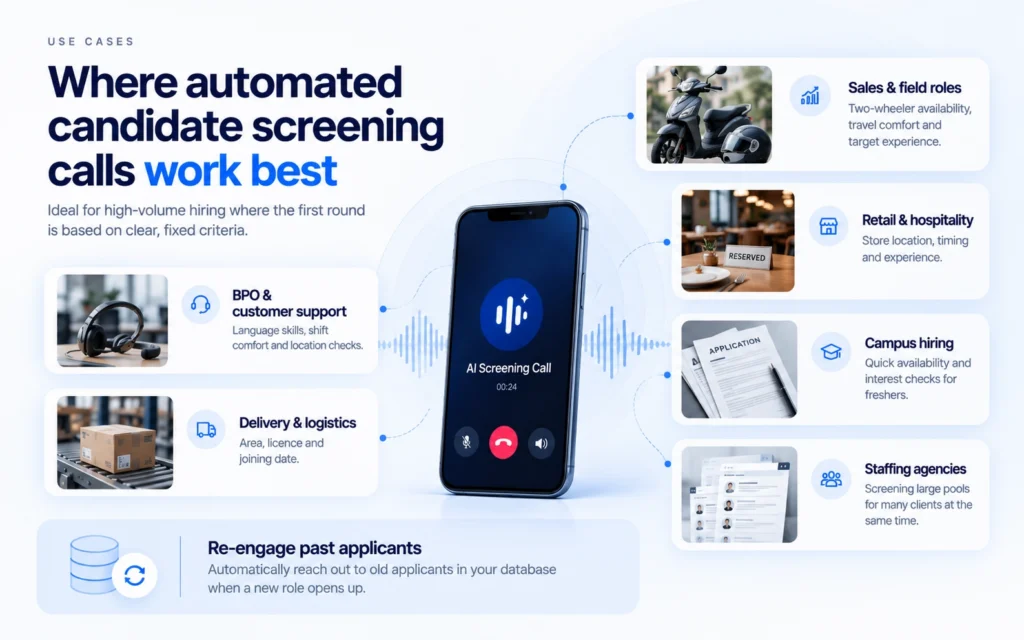
Automated candidate screening calls work best where hiring is high in volume and the first round depends on clear, fixed criteria.
- BPO & customer support: Language skills, shift comfort and location checks.
- Sales & field roles: Two-wheeler availability, travel comfort and target experience.
- Delivery & logistics: Area, licence and joining date.
- Retail & hospitality: Store location, timing and experience.
- Staffing agencies: Screening large pools for many clients at the same time.
- Campus hiring: Quick availability and interest checks for freshers.
And also, automated candidate screening calls can re-engage old applicants in the database when a new role opens up.
AI candidate screening in Hindi & regional languages
A lot of frontline candidates in India are more comfortable speaking Hindi or their own regional language than English. That’s why AI candidate screening in Hindi is not a nice extra, it is often the main requirement.
- The agent should understand Hindi, English and mixed Hinglish answers.
- It should handle local accents and words like “do saal”, “notice ek mahina” or “Noida side”.
- It should switch language if the candidate does.
- It should not mark a candidate down just because they prefer Hindi, unless English is a real job requirement.
Here, what this means is simple: AI candidate screening in Hindi helps companies reach more candidates and judge them on their skills, not just their English.
How a voice AI agent shares scores & summaries with recruiters
After each call, the voice AI agent sends a clear summary to the recruiter instead of just a recording.
| What the recruiter sees | Example |
| Score or status | Shortlisted, on hold or not a fit |
| Key answers | 3 years in sales, Pune, 30-day notice |
| Red flags | Salary much above the band |
| Call summary | A short note on the conversation |
| Recording & transcript | For review if needed |
This usually goes straight into the ATS or a shared sheet, so recruiters can sort and filter shortlisted candidates in minutes.
Systems & integrations needed for AI voice agent for recruitment needs
An AI voice agent for recruitment works best when it is connected to the tools the HR team already uses.
- ATS (applicant tracking system): To pick up new applicants and update their status.
- Job portals & career pages: To trigger calls as soon as someone applies.
- Calendar tools: To book interview slots for shortlisted candidates.
- WhatsApp & SMS: To send interview details, reminders, and document lists.
- HRMS: To pass selected candidates into onboarding.
So the AI voice agent for recruitment should read only the data it needs and update only what the recruiter allows.
Indian rules for voice AI for recruitment: DPDP, TRAI & fair hiring
Voice AI for recruitment in India needs to follow data protection and calling rules from the start.
- DPDP Act, 2023: Candidate names, numbers, call recordings, and answers are personal data. Companies need clear notice, a lawful purpose, and reasonable security safeguards and should delete data that is no longer needed. Most DPDP Rules obligations are expected to apply from May 2027. (Source: SCC Online)
- TRAI rules: Commercial calls fall under TRAI’s TCCCPR framework, and TRAI’s 2025 amendments brought stricter penalties for unregistered telemarketing. Companies should confirm with their telecom provider how calls to applicants are classified.
- Fair questioning: Screening should stick to job-related criteria and avoid personal questions that could lead to discrimination.
- Clear disclosure: Candidates should know they are speaking with an AI agent and how their data will be used.
This is general information, not legal advice, so HR teams should check with their legal or compliance team before scaling voice AI for recruitment.
When the AI should hand over to a human recruiter & why
Even the best voice AI agent should not try to handle every situation. A human recruiter should step in when:
- The candidate asks detailed questions about salary, policies or the team.
- The candidate is a strong fit for a senior or critical role.
- The candidate sounds confused, upset or uncomfortable.
- The candidate asks to speak to a person.
- Something unusual comes up that the script does not cover.
Since you are now aware of where the handoff happens, it becomes clear that voice AI for recruitment is about saving recruiter time, not removing recruiters.
Benefits of AI phone screening candidates & results to expect
The benefits of AI phone screening candidates show up in speed, reach, and recruiter time, which is what most teams want from any voice AI for recruitment setup.
| Area | What usually changes |
| Speed | Automated candidate screening calls reach applicants within minutes, not days |
| Reach | AI candidate screening in Hindi and regional languages brings in more frontline applicants |
| Consistency | Every AI phone screening interview uses the same questions and scoring |
| Recruiter time | Recruiters spend time on shortlisted candidates, not routine calls |
| Data | Each AI pre screening interview adds clean, structured answers to the ATS |
| Availability | A voice AI agent can call in the evenings and on weekends when candidates are free |
Here, what this means is simple: the real results depend on the role and the questions, so teams should measure them in a short pilot.
Why JAM works as an AI voice agent for recruitment & screening
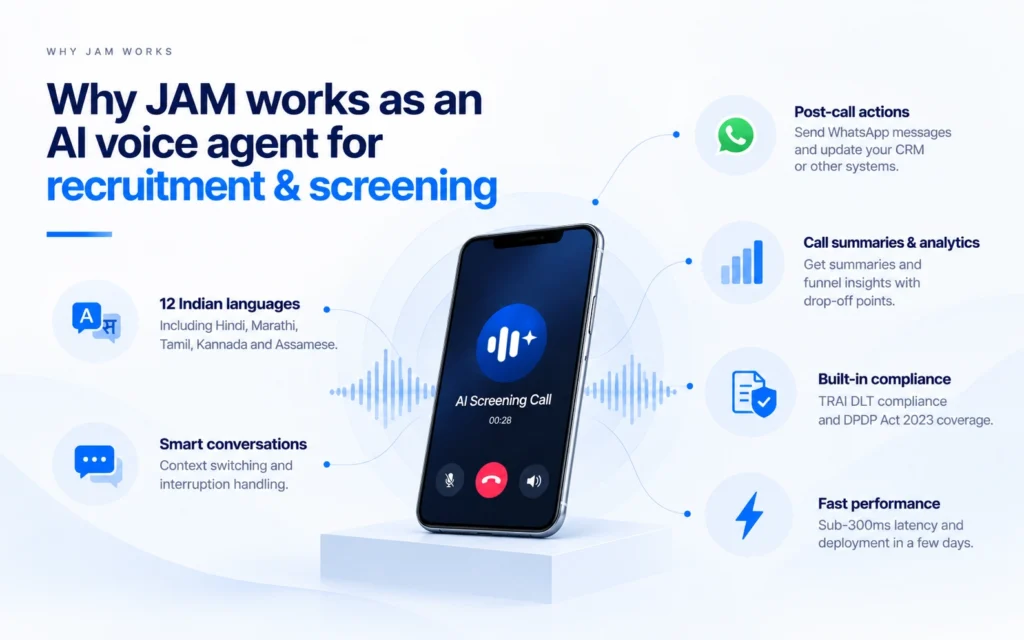
JAM is an enterprise voice AI platform built for high-volume Indian business environments. For recruitment teams running AI phone screening candidates at scale, it offers:
- 12 Indian languages supported natively, including Hindi, Marathi, Tamil, Kannada, and Assamese
- Context switching and interruption handling during live calls
- Post-call actions such as WhatsApp messages and CRM or system updates
- Call summaries and funnel analytics with drop-off points
- TRAI DLT compliance and DPDP Act 2023 coverage built into the platform
- Sub-300ms latency and deployment in a few days
So if your team wants AI candidate screening in Hindi and other Indian languages, JAM is a good place to start.
Conclusion
Since you are now aware of how AI phone screening candidates works, it is clear that the first round of hiring no longer has to depend on recruiters dialling hundreds of numbers every day. A voice AI agent can call every applicant within minutes, ask the same job-related questions, and share a clear score and summary, while recruiters still take the final call on who gets hired.
Automated candidate screening calls also make the process faster and fairer, especially when candidates can speak in Hindi or their own regional language. That’s why more Indian companies are adding AI phone screening candidates to their hiring process. With JAM, recruitment teams can run screening calls in 12 Indian languages, with TRAI DLT and DPDP Act coverage built in, and go live in a few days. So the team spends less time calling and more time hiring the right people.