Banking customer support in India has changed a lot. Customers now want quick answers about their account balance, card status, loan EMIs, KYC updates and complaints, and they want these answers at any time of the day. That’s why conversational AI in Indian banking is becoming a practical option for banks that want to handle routine conversations without making every query depend on a human agent.
Banks that have started using conversational AI are seeing faster replies, shorter queues and support teams that can spend more time on cases that actually need a person.
So if you are also wondering how conversational AI in banking works and whether it is safe, this guide covers what it is, how Indian banks are using it, the benefits, real examples, security checks and the rules banks need to follow.
What is conversational AI in Indian banking & how it works
Here, what conversational AI in Indian banking means is simple: it is technology that lets a customer talk to the bank in normal language, through chat, WhatsApp or a phone call, and get an answer or complete a task without waiting for an agent.
The customer does not have to find the right menu option before getting help. They can simply say “Mera credit card block karna hai” and the system understands what they want, checks their identity, completes the request and confirms it.
| Step | What happens in the conversation |
| Customer asks | The customer types or speaks the request in their own words |
| System understands | Speech recognition and language models work out what the customer needs |
| Identity check | The system verifies the customer through approved steps |
| Action | It checks or updates core banking, card or CRM systems |
| Reply | It confirms the result in simple language |
| Handoff | Sensitive or complex cases move to a human agent with full context |
How Indian banks use conversational AI in banking services for accounts, cards & loans
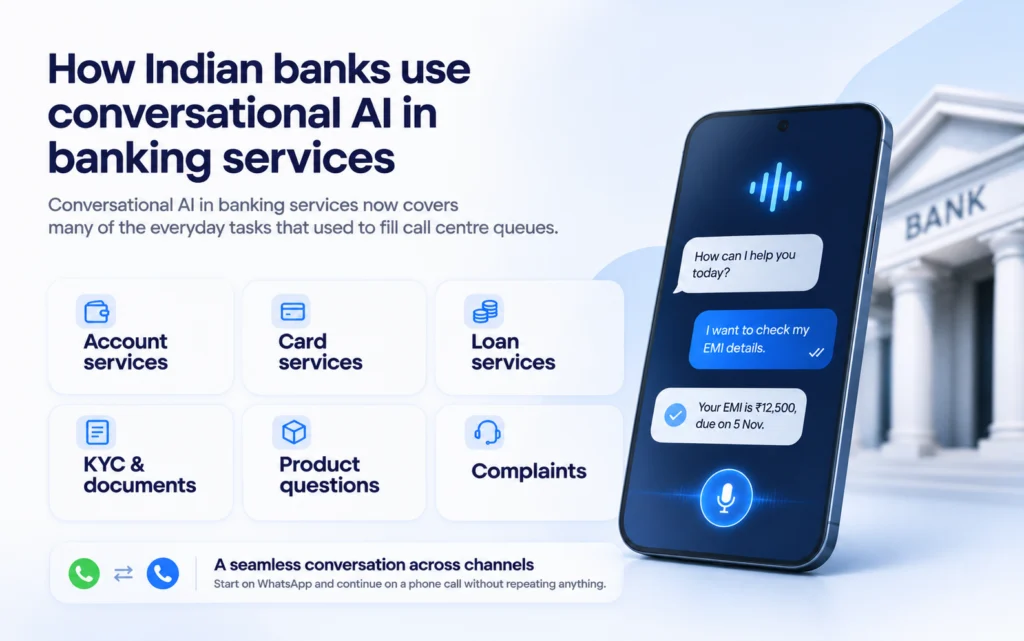
Conversational AI in banking services now covers many of the everyday tasks that used to fill call centre queues.
- Account services: Conversational AI in banking services can share balances, mini statements and cheque book request updates.
- Card services: Customers can block a lost card, check card limits or ask about reward points.
- Loan services: Borrowers can ask about EMI amounts, due dates and loan status, and get a payment link.
- KYC & documents: The bank can remind customers about pending KYC updates and documents.
- Product questions: Customers can ask about deposits, loans and credit cards and get approved answers.
- Complaints: The system can log a complaint and share a ticket number.
And also, the same conversation can move between channels. A customer can start on WhatsApp and then continue on a phone call without repeating everything.
Examples of conversational AI in banking from public & private banks
Looking at real examples of conversational AI in banking makes it easier to see how far Indian banks have come.
| Bank | Assistant | What was reported |
| YES Bank | YES TAG | Described as the first chatbot-based banking in India, launched in April 2016 for transactions on social messengers (Source: Inc42) |
| State Bank of India | SIA | Launched in September 2017, developed by Payjo, and able to handle up to 10,000 enquiries every second (Source: YourStory) |
| HDFC Bank | Eva | Answered 2.7 million customer queries in its first six months (Source: Outlook Business) |
| ICICI Bank | iPal | Answers queries and supports bill payments and fund transfers (Source: Inc42) |
Most of these early examples of conversational AI in banking were text chatbots. The newer examples of conversational AI in banking are voice-based, where AI voice agents for banks in India call customers on a normal phone line for EMI reminders, credit card dues, KYC follow-ups and loan enquiries.
Benefits of conversational AI in banking for banks & customers
The benefits of conversational AI in banking start with faster replies. Customers get answers without waiting in a queue, and banks can keep routine service running even when call volumes go up.
- Faster responses: Customers do not have to wait for an agent for simple questions.
- 24/7 availability: Routine support stays available beyond working hours.
- Consistent answers: Approved responses stay the same across thousands of conversations.
- Language access: The benefits of conversational AI in banking also include support in Hindi and regional languages.
- Lower workload: Teams shift repeated queries to an automated layer.
- Better data: Banks can see common questions, drop-offs and escalation patterns.
- More focused agents: Human agents spend more time on disputes, fraud cases and complaints.
Since you are now aware of the benefits of conversational AI in banking, it is also important to know that these benefits become stronger when the system is connected to the right banking systems. A bot that only talks can still leave work for the support team. A system that understands, checks and completes the request removes much more friction.
AI customer support in banking: Chat, WhatsApp & voice
AI customer support in banking works across chat, WhatsApp and phone calls, and each channel suits a different kind of customer.
| Channel | Works well for | Common tasks |
| Website & app chat | Customers who like typing | FAQs, statements, quick updates |
| Customers who already use it daily | Balance, card status, payment links | |
| Voice calls | Customers who prefer speaking | Reminders, follow-ups, urgent queries |
Here, what this means is simple: AI customer support in banking works best when all channels share the same data and rules, so the customer gets the same answer wherever they ask.
AI voice agents for banks in India & why voice matters
Many Indian customers, especially outside big cities, find it easier to speak than to type. AI voice agents for banks in India can make outbound calls for reminders and pick up inbound calls in Hindi, Hinglish and regional languages. That’s why AI voice agents for banks in India are now becoming an important part of AI customer support in banking.
Is conversational AI in banking secure? Identity checks & safeguards
Yes, conversational AI in banking can be used safely when the bank puts the right controls around it. Security should be part of the setup from the first day, not added later.
- Identity verification: Share account details only after approved checks like registered mobile number verification, OTP or security questions.
- Data masking: Hide card numbers, account numbers and other sensitive details in logs and transcripts.
- Approved answers: The system should answer only from approved data and never guess balances, rates or policies.
- Limited actions: Allow only defined actions, and keep high-risk tasks like fund transfers behind stronger checks.
- Fraud safety: The system should never ask for full card numbers, PINs or passwords.
- Human handoff: Fraud reports, disputes and complaints should go straight to trained staff.
What a secure banking AI call sounds like
- “Namaste, main XYZ Bank se baat kar rahi hoon. Verification ke liye, kya aap apni date of birth confirm kar sakte hain?”
- “Dhanyavaad. Aapka card block ho gaya hai. Hum kabhi bhi aapka PIN ya password nahi poochenge.”
- “Is transaction ke baare mein shikayat ke liye, main aapko hamare fraud team se jod rahi hoon.”
So AI customer support in banking is only as safe as the guardrails the bank sets around it.
RBI, DPDP & rules for conversational AI in Indian banking
Banks that use conversational AI still have to follow RBI guidelines, data protection law and telecom rules.
Did you know? In August 2025, RBI released the report of its committee on a Framework for Responsible and Ethical Enablement of AI (FREE-AI), which sets out 7 Sutras and 26 recommendations under six pillars for AI in the financial sector. (Source: Reserve Bank of India)
- RBI expectations: Fair practices and customer protection apply, and the bank stays responsible for any outsourced service.
- DPDP Act: Customer data, recordings and transcripts are personal data, and most DPDP Rules obligations are expected to apply from May 2027. (Source: SCC Online)
- TRAI rules: Commercial calls fall under TRAI’s TCCCPR framework, and the 2025 amendments brought stricter penalties for unregistered telemarketing. (Source: TRAI)
- Collections conduct: RBI asks lenders not to call borrowers before 8 am or after 7 pm for recovery of overdue loans. (Source: Business Standard)
So if you are evaluating conversational AI for a bank, compliance should be part of the buying checklist from the start. This is general information, not legal advice, so banks should confirm details with their compliance team.
How to start & scale conversational AI in banking services
Starting with conversational AI in banking services becomes easier when the bank picks one clear use case first.
- Pick one workflow: EMI reminders, card blocking or balance queries usually work well to begin with.
- Write approved answers: Agree on scripts, data sources and limits with product and compliance teams.
- Set identity checks: Decide what verification is needed before sharing any details.
- Connect systems: Link core banking, card, LMS and CRM systems through secure APIs.
- Test in real languages: Try Hindi, Hinglish and regional accents on real phone lines.
- Track results: Measure containment rate, handoff rate, customer satisfaction and cost per resolved query.
Banks that start small with conversational AI in banking services and AI voice agents for banks in India usually find it much easier to scale and see the benefits of conversational AI in banking sooner.
Why JAM is built for conversational AI in Indian banking & customer calls
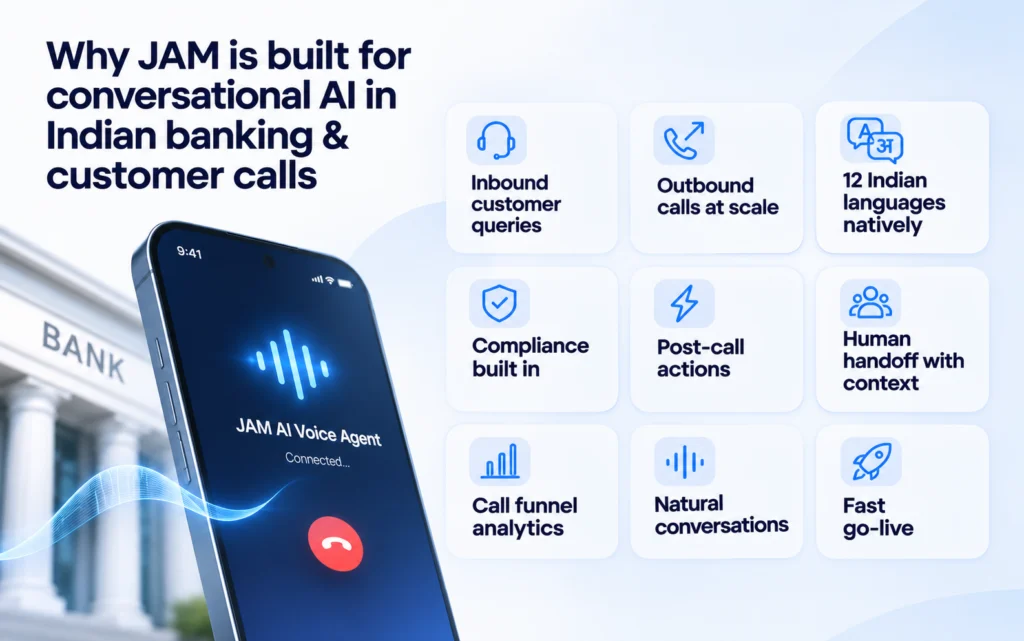
JAM (Just A Moment), is an enterprise voice AI platform built for high-volume, compliance-heavy Indian business environments. For banks, it brings conversational AI to the phone line, where many customers still prefer to talk.
- Inbound customer queries: Account servicing, loan queries and payment questions are handled without agent involvement.
- Outbound calls at scale: EMI reminders, KYC follow-ups and collection calls run automatically.
- 12 Indian languages natively: These include Hindi, Marathi, Tamil, Kannada and Assamese, with Hinglish and mid-call language switching handled naturally.
- Compliance built in: TRAI DLT compliance, RBI fair practices alignment and DPDP Act 2023 coverage come with the platform.
- Post-call actions: WhatsApp messages, payment links, CRM updates and document verification triggers fire automatically after every call.
- Human handoff with context: Fraud reports, disputes and sensitive cases move to bank staff with the full conversation summary.
- Call funnel analytics: Teams can see drop-off points and resolution rates across every call type.
- Natural conversations: Sub-300ms latency keeps calls real-time, even at scale.
- Fast go-live: JAM deploys in a few days.
So banks do not have to build the full voice stack themselves. JAM gives them AI voice agents for banks in India that already understand Indian languages, Indian calling rules, and real banking workflows.
Conclusion
Since you are now aware of how conversational AI in Indian banking works, it is clear that customer conversations are becoming faster and easier for both the bank and the customer. From early examples of conversational AI in banking like SIA and Eva to AI voice agents that call customers in Hindi and regional languages, conversational AI in banking services can now handle everyday tasks while human teams focus on complex and sensitive cases.
Well, the benefits of conversational AI in banking only last when the setup has strong identity checks, approved answers, secure data handling, and compliance with RBI, DPDP, and TRAI rules. That’s why choosing the right platform matters as much as the decision to automate. With JAM, banks get AI voice agents for banks in India that speak 12 Indian languages natively, come with TRAI DLT, RBI fair practices and DPDP Act 2023 coverage built in, update systems and send links after every call, and go live in a few days.